
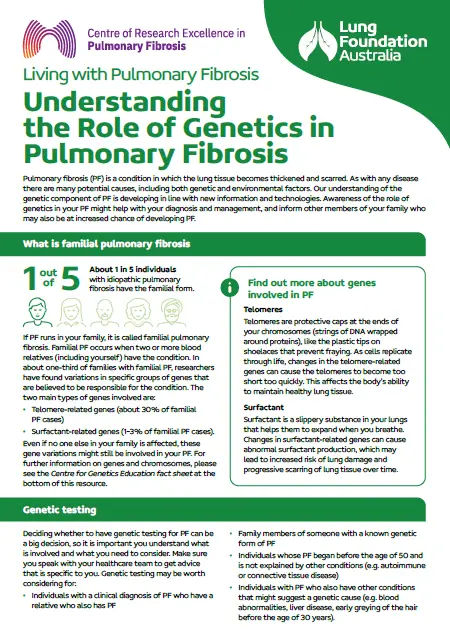
Pulmonary fibrosis (PF) is a condition where the lungs become thickened and scarred, making it harder to breathe over time. While PF can happen for many reasons, research shows that genetics can play an important role. Understanding whether your PF has a genetic cause can help guide your care and may also be useful for your family.
When PF occurs in two or more close relatives, it is called familial pulmonary fibrosis. In some families, changes in specific genes contribute to the condition. The most common are telomere‑related genes, which help protect your DNA, and surfactant‑related genes, which help keep your lungs functioning smoothly. Variations in these genes can make lung tissue more vulnerable to damage and scarring.
Genetic testing may be recommended if PF runs in your family, if you were diagnosed at a young age, or if you have other health features that suggest a genetic cause. Testing usually involves meeting with a respiratory specialist and a genetic counsellor, followed by a simple blood or saliva test. Results can take several months.
If a genetic variant is found, it may help explain the cause of your PF, guide treatment decisions and highlight whether other family members could be at increased risk. However, having a genetic variant does not mean you will definitely develop PF. Factors like age, environmental exposures and other health conditions also influence whether PF appears and how it progresses.
If no variant is found, a genetic cause is still possible. Genetic science is evolving quickly, so re‑testing in the future may be recommended.
Understanding the genetic side of PF can help you make informed decisions, support early detection in families and feel more confident navigating your care.
Was this page helpful?
Good job! Please give your positive feedback
How could we improve this post? Please Help us.