
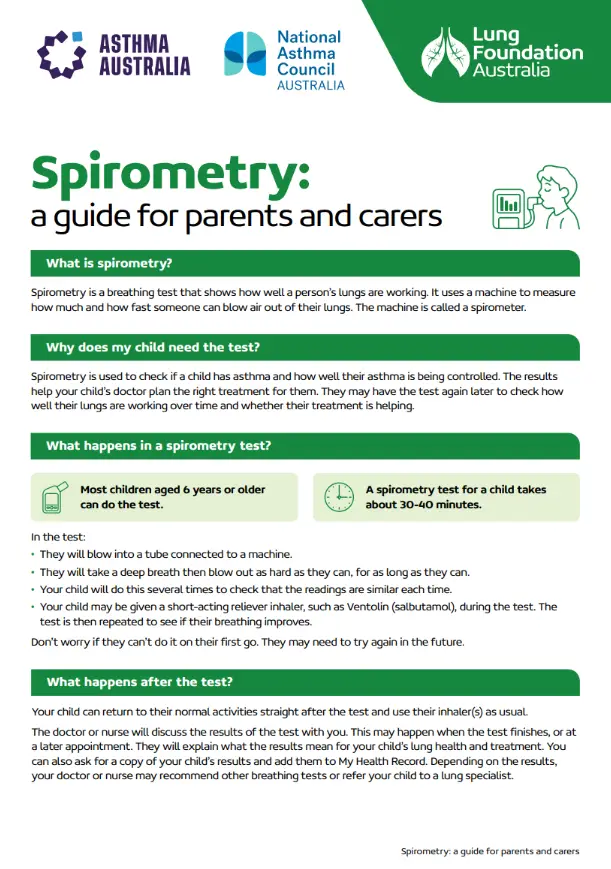
This fact sheet explains what spirometry is, why your doctor may recommend it, what happens during the test, and how to prepare for your appointment. It also answers common questions about spirometry, including safety, cost, and what your results mean.
Spirometry is a simple breathing test that measures how well your lungs are working. It helps healthcare professionals understand how much air you can breathe out and how quickly you can do it. The test is commonly used to diagnose and monitor lung conditions such as asthma and chronic obstructive pulmonary disease (COPD).
During a spirometry test, you breathe into a machine called a spirometer. You will be asked to take a deep breath and then blow out as hard and for as long as you can. The test is repeated a few times to make sure the results are accurate. In some cases, you may also be asked to use a reliever inhaler, such as Ventolin (salbutamol), so your healthcare professional can see whether your breathing improves after taking the medication.
Spirometry is a safe, low-risk test that usually takes around 20 to 30 minutes. It is not painful, although some people may feel slightly tired or dizzy from the effort required. These feelings are usually mild and pass quickly. A trained healthcare professional will guide you through the test and explain each step along the way.
The results of a spirometry test help your doctor diagnose lung conditions, assess how well your lungs are functioning, and determine whether your treatment is working. You may be asked to repeat the test over time to monitor changes in your lung health and track your response to treatment.
The fact sheet also includes practical tips to help you prepare, including what to bring, which inhalers may need to be stopped before the test, and activities to avoid beforehand. It explains when spirometry may need to be delayed and what costs may be involved.
Download the fact sheet to learn more about what to expect before, during and after spirometry, and how the test can help you and your healthcare team better understand your lung health.
Was this page helpful?
Good job! Please give your positive feedback
How could we improve this post? Please Help us.